Corn Harvest Moisture: What It Means and Why It Matters
Harvest moisture affects your drying costs, storage safety, and the bu/acre number you actually get paid for. How to manage it and what it means.
By Corn Yield Calculator Team · Last updated
Quick Answer
Corn is traded at a standard 15.5% moisture basis. If you harvest at higher moisture, you'll pay drying costs or receive a moisture discount. Harvesting at 20% moisture typically costs $0.03–$0.06 per bushel per point of moisture removed (depending on energy costs). Our corn yield calculator automatically adjusts your field estimate to the 15.5% dry basis.
Grain moisture is one of those numbers that affects everything downstream from harvest: what you pay to dry it, how safely you can store it, and what the elevator actually pays you for it. Most producers understand it generally, but the details of how moisture adjustments work and why they matter so much at the margins are worth knowing precisely.
What Is Grain Moisture Content?
Grain moisture content is the percentage of a grain sample's total weight that is water. At 20% moisture, 20% of what you weigh on the scale is water, not corn dry matter. That water will be removed during drying or, if stored wet, will support mold, respiration losses, and eventually spoilage.
The standard moisture basis for corn in U.S. grain contracts is 15.5%. This means a 56-lb bushel of corn at 15.5% moisture contains:
- 47.3 lbs of dry matter
- 8.7 lbs of water
When you harvest at 22% moisture, each "bushel" weighs more than 56 lbs — but the extra weight is all water. The elevator will adjust your scale ticket to the 15.5% equivalent, which is what you actually get paid for.
The Moisture Adjustment Formula
The formula used to convert wet-basis yield to dry-basis yield is:
Adjusted bu/acre = Raw bu/acre × (100 − Harvest MC%) ÷ (100 − 15.5%)
For example, a field that estimates 185 bu/acre at 22% moisture:
185 × (100 − 22) ÷ (100 − 15.5) = 185 × 78 ÷ 84.5 = 170.8 bu/acre at 15.5% MC
That's a 14.2 bu/acre difference, about 8% of the gross yield, that simply represents the water weight you lose in drying. Our yield estimator does this math automatically when you enter your current field moisture.
Drying Costs: What You're Actually Paying
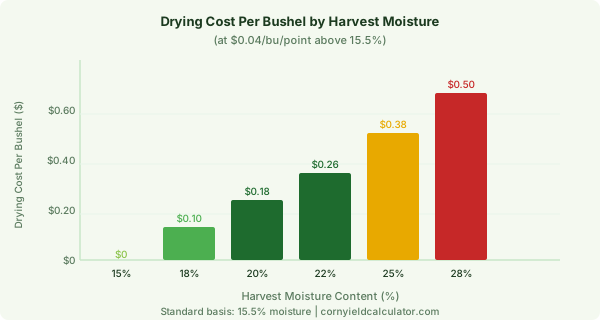
Commercial drying at an elevator typically costs $0.03–$0.06 per bushel per point of moisture removed from 15.5%. "Points" of moisture = percentage points above 15.5.
At $0.04/bu/point:
- Harvest at 20% (4.5 points wet): 4.5 × $0.04 = $0.18/bu
- Harvest at 25% (9.5 points wet): 9.5 × $0.04 = $0.38/bu
- Harvest at 30% (14.5 points wet): 14.5 × $0.04 = $0.58/bu
On a 200 bu/acre field at $0.04/bu/point:
- Harvesting at 25% instead of 22% costs you an extra $24/acre in drying
- On 500 acres, that's $12,000 in additional drying expense for three extra moisture points
These numbers look small per bushel but add up fast at scale. At current propane and natural gas prices, on-farm dryer operating costs run $0.02–$0.05 per point per bushel depending on equipment efficiency and fuel costs.
Optimal Harvest Moisture: The Tradeoff
The conventional wisdom is to harvest between 18–22% moisture for corn destined for commercial drying. Here's why that window exists:
Too wet (above 25–28%):
- Drying costs escalate rapidly
- Kernel damage in the combine increases (wet kernels don't shell cleanly)
- Combines work slower, reducing daily capacity
- Field conditions often deteriorate, increasing soil compaction and harvest losses
Too dry (below 15.5%):
- You've already done the drying in the field, which costs nothing
- BUT: below about 16%, kernel cracking from the shelling action increases
- Cracked corn grades lower and is more susceptible to mold during storage
- You've left the moisture shrinkage "profit" in the field. The crop dried down from something higher, and field losses from husks opening and kernel drop may have occurred
The sweet spot for most operations is 18–21% at harvest, which balances drying cost against field losses and harvest quality. Hybrids with good "staygreen" characteristics and strong husks hold their moisture and quality better when harvest is delayed into wetter fall conditions.
How Moisture Affects Your Yield Estimate
When you use the ear-count method to estimate yield pre-harvest, you're counting physical kernels — not dry matter. The kernel weight factor (kernels per bushel) you choose already reflects expected grain fill, but it doesn't account for moisture.
This is why our corn yield calculator asks for current moisture: it adjusts your raw ear-count estimate to the 15.5% standard, giving you the number that translates directly to your expected grain check.
If you're scouting at R4 stage when moisture is typically 35–40%, your "raw" estimate will be much higher than your actual harvest check. Enter the current field moisture and the adjusted yield is what matters.
Storage Safety and Moisture Limits
If you're storing grain rather than selling at harvest, moisture management is even more critical.
Safe storage moisture by duration:
- Long-term storage (9–12 months): target 13–14% moisture
- Medium storage (3–6 months): 14–15% is acceptable in cool climates
- Short-term (less than 60 days): up to 15.5% if temperatures stay below 40°F
Corn stored above 15.5% moisture in warm conditions will begin dry matter respiration, which generates heat and creates conditions for mold growth. The rule of thumb: for every 1% above safe moisture, your maximum safe storage time is roughly halved.
Aeration is essential for any stored grain above 13%. Cool the grain to below 40°F as quickly as possible after harvest to extend your safe storage window.
Using Harvest Moisture Data
At the end of each harvest season, log your combine moisture readings alongside yield monitor data by field zone. Over 3–5 years, this tells you:
- Which hybrids dry down fastest (important for early harvest scheduling)
- Which field zones tend to stay wetter (drainage or soil issues)
- How your average harvest moisture compares to your dryer's optimal intake range
This data also helps you make better hybrid selection decisions the following spring. A hybrid that yields 5 bu/acre more but consistently harvests at 22% instead of 19% may actually be less profitable after accounting for drying costs, especially as energy prices climb.
For more on what drives overall yield performance, read our guide on 7 factors that affect corn yield. And when you're ready to estimate next year's crop pre-harvest, our corn yield calculator makes the moisture adjustment automatically.
Corn Yield Calculator Team
Agronomists and farmers building free, accurate crop scouting tools. Learn about our methodology →
Try the Corn Yield Calculator
Calculate corn yield per acre using ear count, kernel rows, and kernel weight data from your field.