Understanding Corn Kernel Weight and Its Impact on Yield
Kernel weight is the most variable input in the corn yield formula. What drives kernels-per-bushel and how to pick the right value for your field.
By Corn Yield Calculator Team · Last updated
Quick Answer
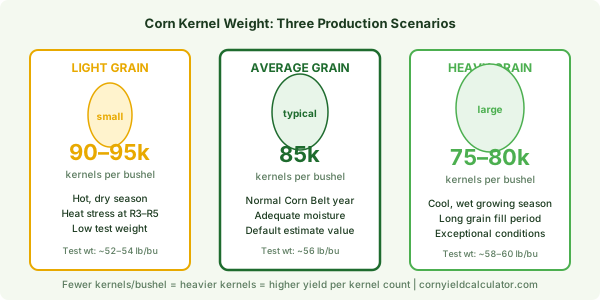
Kernel weight in the corn yield formula is expressed as the number of kernels per 56-pound bushel. The average Corn Belt value is 85,000 kernels/bu. Hot, dry conditions produce lighter kernels (75,000–80,000). Cool, wet conditions with strong grain fill produce heavier kernels (88,000–95,000). Choosing the wrong value shifts your yield estimate by 10–20 bu/acre.
Of the three field measurements you put into the corn yield formula — ears per acre, rows per ear, and kernels per row — kernel weight is the one you estimate rather than count. And it's the most variable. A 10,000-kernel difference in your kernels-per-bushel estimate shifts a 200 bu/acre field by 23 bu/acre.
Getting this number right matters. Here's everything you need to know about what drives corn kernel weight and how to pick the right value for your field.
Why Kernels Per Bushel, Not Weight Per Kernel?
The yield formula works backward from the way you might expect. Rather than weighing individual kernels, agronomists express kernel weight as the number of kernels required to make one standard 56-pound bushel of corn.
- Fewer kernels per bushel = heavier individual kernels = more pounds per kernel = higher yield for the same kernel count
- More kernels per bushel = lighter individual kernels = less yield per kernel
So when you select "Heavy (90,000 kernels/bu)" in our corn yield calculator, you're telling the formula that each kernel weighs less, which results in a lower yield estimate for the same ear count and kernel count. Counterintuitive until you understand the math.
What Determines Kernel Weight?
Four main factors drive corn kernel weight in any given season.
Growing Season Temperature During Grain Fill
High temperatures (above 95°F) during grain fill, which runs roughly from R3 (milk) through R6 (black layer), are the primary driver of lightweight kernels. Heat accelerates the kernel development timeline, shortening the grain-fill duration and reducing dry matter accumulation per kernel.
Research from the University of Illinois shows that each day above 95°F during grain fill reduces final kernel weight by approximately 1.5%. A 2-week heat event during mid-grain fill can push kernels from an 85,000 average to 78,000–80,000 kernels/bushel.
Water Availability During R4–R6
The source of dry matter for grain filling is current photosynthesis plus carbon reserves stored in the stalk and leaf tissue. Drought stress that limits photosynthesis during R4–R5 forces the plant to rely more heavily on stalk remobilization, which simultaneously reduces kernel dry matter accumulation and weakens stalk integrity.
Fields that show significant stalk cannibalization (stalks that crush when pushed or pierce easily with a probe) during R5–R6 will typically show lower-than-expected kernel weights at harvest.
Hybrid Genetics
Some hybrids are bred specifically for kernel depth and kernel density. A deeper kernel (taller in the crown-to-tip dimension) naturally accommodates more starch than a flat kernel, everything else equal. Hybrid test weight data, reported as pounds per bushel at 15.5% moisture, is a reasonable proxy for kernel weight potential.
Test weight below 54 lbs/bu (standard is 56 lbs/bu) correlates with lighter kernels and higher kernels-per-bushel values. Most commercial hybrids target 56–58 lbs/bu test weight under normal conditions.
Timing of Scouting Relative to Black Layer
When you count kernels at R4 (dough stage), the kernels are still accumulating dry matter. If you use an 85,000 kernels/bu estimate at R4 but there's still 20+ days of grain fill remaining and conditions are good, your final yield may run 5–10% higher than your early estimate. At R5 (dent), the estimate is much more reliable because most dry matter accumulation has occurred.
Choosing the Right Value for Your Estimate
The four options in our calculator correspond to these field conditions:
75,000 kernels/bu — Light:
Use this when conditions during grain fill have been clearly exceptional: cool nights, adequate moisture throughout July and August, and a long grain-fill period without stress. These kernels are noticeably plump and heavy. This value is appropriate maybe 10–15% of Corn Belt years.
85,000 kernels/bu — Average:
The default and most commonly appropriate value. Use this for normal Corn Belt conditions: adequate rainfall, no prolonged heat events, reasonable grain fill duration. This is the value Purdue Extension recommends as the starting point.
90,000 kernels/bu — Heavy:
Use when you've experienced some stress during grain fill — 1–2 weeks of hot, dry weather in late July or early August — or when scouting at R4 with conditions still uncertain. Slightly conservative, which is usually appropriate when you have less certainty.
95,000 kernels/bu — Very Heavy:
Reserved for drought years, years with extended heat events during R3–R5, or situations where test weight data from your area is already running low (below 54 lbs/bu). This gives a conservative estimate that reflects genuinely light grain.
A Practical Decision Rule
If you're scouting at R4 and don't have a strong read on conditions yet, use 90,000 as your default rather than 85,000. It's better to be pleasantly surprised at the elevator than to sell forward based on an optimistic pre-harvest estimate.
If you're scouting at R5 in a year with good weather throughout grain fill, 85,000 is usually right. In a year where you saw significant mid-season drought or extended heat above 95°F, go with 90,000–95,000.
The best calibration is to compare your pre-harvest estimates to combine data from previous years, noting which kernel weight assumption produced the most accurate results in your environment. Over 3–5 years, that comparison will tell you whether your fields tend to run light or heavy.
How Kernel Weight Affects Your Yield Estimate
Here's the math with a real example. You count 30,000 ears/acre, 16 rows, 34 kernels/row = 16,320,000 kernels/acre.
| Kernel Weight (kernels/bu) | Estimated Yield |
|---|---|
| 75,000 | 217.6 bu/acre |
| 85,000 | 192.0 bu/acre |
| 90,000 | 181.3 bu/acre |
| 95,000 | 171.8 bu/acre |
That's a 46 bu/acre spread across the four options — from the same ear count and kernel count data. Getting this one variable right can mean the difference between a marketing decision that's accurate and one that's off by $100/acre.
Run your own numbers in our corn yield calculator and compare the sensitivity between kernel weight options for your specific ear count data. For a complete walk-through of the scouting process, see how to scout corn for yield.
Corn Yield Calculator Team
Agronomists and farmers building free, accurate crop scouting tools. Learn about our methodology →
Try the Corn Yield Calculator
Calculate corn yield per acre using ear count, kernel rows, and kernel weight data from your field.