How to Scout Corn for Yield: Step-by-Step Field Guide
A practical field-scouting guide for estimating corn yield before harvest: sampling locations, ear measurement, and mistakes that skew your numbers.
By Corn Yield Calculator Team · Last updated
Quick Answer
Scout corn for yield at R4 (dough) to R5 (dent) stage, 4–6 weeks before harvest. Count ears in 1/1,000th acre plots, measure 5–10 ears per site for rows and kernels, and sample at least 5 locations spread across the field. Enter your counts into the corn yield calculator for a fast bu/acre estimate.
Pre-harvest yield scouting is one of the most useful things you can do with an afternoon in August. It helps you plan storage, make marketing decisions, and understand whether your management practices paid off before the combine answers those questions for you.
The method described here is the University Extension ear-count approach, validated by Purdue University and Iowa State University agronomists and used across the Corn Belt for decades.
When to Start Scouting
The best yield estimates come at R4 (dough) through R5 (dent) stage, roughly 4–6 weeks before harvest. At R4, you'll see pasty or doughy material when you squeeze a kernel. At R5, kernels are beginning to dent at the crown.
Scouting earlier (R3, milk stage) is possible but will over-predict yield because kernel weight is still largely undetermined. Scouting after black layer formation is fine for a final estimate, but by that point you might as well wait for the combine.
If you're looking to make marketing decisions, scout at R4–R5 when you still have time to act. If you want to verify your hybrid selection, a post-harvest field check combined with combine monitor data gives you more complete information.
Equipment You Need
You don't need much:
- Measuring tape or premeasured flag markers (17.4 feet for 30-inch rows, 14.5 feet for 36-inch rows, 26.2 feet for 20-inch rows)
- A pad and pencil or your phone for recording counts
- A knife or fingernail for checking kernel stage
- A bag to collect sample ears
That's it. No special tools. A grain moisture meter helps if you want to factor current moisture into your estimate, but it's optional.
Choosing Sampling Locations
This is where most scouts go wrong. Do not sample in the best-looking part of your field. Pick locations that represent the whole field, including the good areas, the average areas, and the struggling areas.
Ground rules for location selection:
- Stay at least 30 rows from the field edge. Edge rows often have abnormally high ear counts due to reduced competition, and they'll skew your average upward.
- Avoid waterways, severely compacted areas, or spots with obvious pest damage. Scout those separately if you want to estimate their yield impact.
- For a 40-acre field: 5 sampling sites minimum. For 100+ acres: 8–10 sites. Large, variable fields benefit from more samples.
- Spread sites evenly across the field in a zigzag or grid pattern, not clustered in one area.
Step 1: Count Ears per Sample Site
At each location, measure out 1/1,000th of an acre in the row direction:
- 30-inch rows: 17.4 feet of row
- 36-inch rows: 14.5 feet of row
- 20-inch rows: 26.2 feet of row
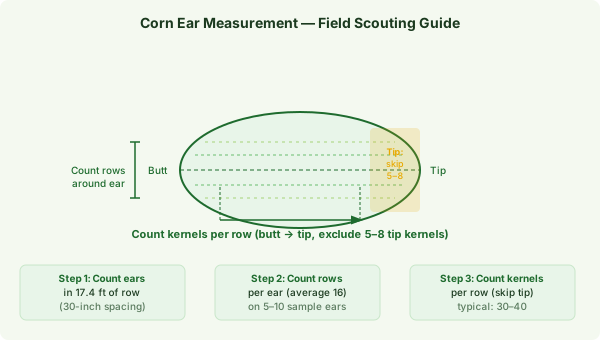
Count every harvestable ear in that stretch. This includes both plants in a two-plant section if you're in twin rows, or every stalk in a single row if not. Count nubbins and small ears too; the combine will likely pick them up. Write down the count.
Multiply that single-site ear count by 1,000 to get ears per acre for that location. Average across all your sites.
Step 2: Select and Measure Sample Ears
At each site, after counting ears, pull 5–10 ears at random. "At random" means grabbing ears from throughout the counted stretch, not just the biggest ones nearby. Put them in your bag.
Counting kernel rows:
Hold each ear at mid-length. Count the rows of kernels around the circumference. They always come in even numbers. The average for commercial corn hybrids is 16 rows, though 14 and 18 are common depending on the hybrid and environment. Write down the row count for each ear and average them.
Counting kernels per row:
Pick one row on each ear and count from the butt (where the ear attaches to the shank) toward the tip. Exclude the tip: skip the last 5–8 kernels, which are typically smaller and irregularly filled. Excluding the tip gives you more consistent, comparable data across ears. Write down the kernel count per row for each ear and average them.
Step 3: Calculate or Estimate Yield
Once you have your three averages — ears/acre, rows/ear, kernels/row — you can calculate:
Yield (bu/acre) = (Ears/acre × Rows/ear × Kernels/row) ÷ Kernels/bushel
The kernels-per-bushel figure varies with growing conditions. Use 85,000 for an average year, 80,000 for a tough year with light, shrunken kernels, and 90,000–95,000 for an exceptional year with heavy grain.
Or just plug everything into our free yield estimator, which handles the math and adjusts for moisture content automatically.
Example calculation:
- 30,000 ears/acre × 16 rows × 34 kernels/row = 16,320,000 kernels/acre
- 16,320,000 ÷ 85,000 = 192 bu/acre at harvest moisture
Common Scouting Mistakes
Mistake #1: Sampling near the field edge. Edge effects can inflate your ear count by 10–20% compared to the field interior.
Mistake #2: Counting only at R3 (milk stage). Kernel weight is the least predictable variable at this stage, so your estimate will often run 20–30 bu/acre high.
Mistake #3: Using too few sample ears. Two or three ears per site is not enough. Natural ear-to-ear variation can swing your kernels-per-row count by 5–8 kernels. More ears = more stable average.
Mistake #4: Including tip kernels in the row count. The tip fills last and is most affected by pollination stress. Including it adds inconsistency between a good-tip ear and a tip-back ear.
Mistake #5: Sampling only average-looking spots. A yield estimate is only useful if it's representative. Scout the problem areas too and estimate their proportion of total field acres.
Interpreting Your Results
Once you have an estimate, compare it to:
- Your APH (actual production history) for that field
- The county average from USDA NASS
- Last year's combine monitor data for the same field zones
A 10–15% margin of error is normal with the ear-count method. If your estimate is significantly above or below expectations, re-scout that field before making marketing decisions.
For a full discussion of what drives yield differences between fields and years, read our guide on 7 factors that affect corn yield. To understand how your estimate compares to state and national benchmarks, see average corn yield per acre by state.
Once you've collected your field data, run your estimate here. It takes about two minutes.
Corn Yield Calculator Team
Agronomists and farmers building free, accurate crop scouting tools. Learn about our methodology →
Try the Corn Yield Calculator
Calculate corn yield per acre using ear count, kernel rows, and kernel weight data from your field.