Optimal Corn Plant Population: What the Research Says
Planting population is the biggest lever you control at planting. Research-based seeding rates by soil type, yield environment, and hybrid.
By Corn Yield Calculator Team · Last updated
Quick Answer
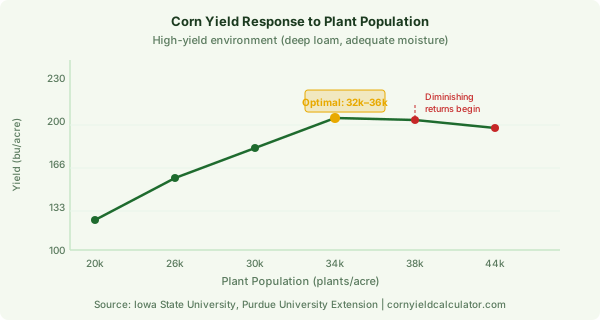
Most research-based recommendations put optimal corn plant population between 30,000–36,000 plants per acre for high-yield environments (Class 1 soils, adequate moisture). Yield response to population is roughly linear from 20,000 to 34,000 plants/acre, then flattens and eventually turns negative above 40,000 plants/acre in most environments.
Planting population is the most consequential decision you make at planting time. Unlike hybrid selection, which you can evaluate after the season ends, population decisions lock in your yield ceiling before a single seed germinates.
Too few plants: you leave bu/acre on the table. Too many: you overspend on seed and, in stress years, create competition that reduces kernel weight and increases standability problems.
Here's what decades of university research from Purdue, Iowa State, and the University of Illinois says about finding the right number for your operation.
The Yield-Population Relationship
The relationship between plant population and yield follows a classic agronomic response curve: linear increase, plateau, then slight decline.
In most environments, each 1,000-plant increase from 20,000 to 34,000 plants/acre adds approximately 4–7 bu/acre. Between 34,000 and 38,000 plants/acre, the response flattens to 1–3 bu/acre per 1,000 plants. Above 38,000–40,000 plants/acre, yield either stays flat or begins to decline as inter-plant competition increases and ear size compensates downward.
The exact breakpoint varies by:
- Soil productivity and yield potential: higher-yield environments support higher populations
- Water availability: irrigated corn can sustain higher populations than dryland
- Hybrid stature: shorter, more upright hybrids handle higher populations better than tall, leafy types
- Tillage and row spacing: narrow rows (20-inch) distribute light more efficiently, supporting slightly higher populations
Research-Based Guidelines by Yield Environment
These ranges come from multi-year, multi-location university trials. Your specific hybrid and soil type matter, but these are reliable starting points.
High-yield environments (190+ bu/acre potential, deep loam soils, adequate moisture):
- Target 34,000–36,000 seeds/acre
- Harvest stand of 32,000–34,000 plants/acre
- Assumes 95% emergence efficiency
Medium-yield environments (150–190 bu/acre potential):
- Target 32,000–34,000 seeds/acre
- Harvest stand of 30,000–32,000 plants/acre
Low-yield environments (under 150 bu/acre, sandy or dry soils):
- Target 28,000–30,000 seeds/acre
- Higher populations in these environments increase water competition without adding ears
Dryland corn (Kansas, western Nebraska, eastern Colorado):
- 18,000–24,000 plants/acre is often optimal
- Water, not light, is the yield-limiting resource: lower populations reduce competition for soil moisture
The Difference Between Seeding Rate and Final Stand
Your planting population (seeds dropped per acre) and your harvest stand (ears per acre) are not the same number. Emergence losses of 2–8% are normal due to:
- Seed-to-soil contact issues in cloddy seedbeds
- Soil crusting after heavy rain
- Seed insect damage
- Cold soil temperatures delaying or killing germination
If you're targeting a harvest stand of 32,000 plants/acre and you expect 95% emergence, you should seed at 33,700 seeds/acre (32,000 ÷ 0.95).
In wet, cloddy, or cold conditions where emergence might drop to 88%, that same 32,000 target requires 36,400 seeds/acre at planting.
This math matters because it directly affects your ears-per-acre estimate, which is the most important input in the corn yield calculator. An acre that gets a 92% emergence rate at 34,000 seeds will come in at 31,280 ears, not 34,000. That difference costs about 10–14 bu/acre at average rows/ear and kernels/row.
Variable Rate Seeding
Variable rate seeding (VRS) technology allows you to adjust planting population across a field based on soil productivity zones rather than applying one rate uniformly. Research from multiple universities shows:
- VRS saves seed cost by reducing rates on low-productivity areas
- VRS can add 3–8 bu/acre on high-productivity areas where the flat rate was too low
- The ROI on VRS equipment depends on field variability; flat, uniform fields show little benefit
To implement VRS effectively, you need a current soil productivity map or EC (electrical conductivity) scan, yield monitor data from 3+ seasons, and a planter controller capable of adjusting rates on-the-go.
Checking Your Stand Post-Emergence
After emergence (V2–V3), count plants in 1/1000th acre segments at 5+ field locations to verify your actual stand. Compare to your target.
If your stand is more than 10% below target, assess the cause before deciding whether to replant. In most years, replanting corn after May 15 in the northern Corn Belt and May 25 further south is not economically justified unless you're below 16,000 plants/acre with highly uneven spacing.
Stand counts and ear counts are the starting point for every yield estimate. When you're ready to scout your field pre-harvest, use our yield calculator to turn those ear counts into a bu/acre projection.
For broader management context, read our guide on 7 factors that affect corn yield, which covers population alongside nitrogen, water, and disease pressure. And to understand how your ears-per-acre count translates to yield, see our guide to counting ears per acre accurately.
Corn Yield Calculator Team
Agronomists and farmers building free, accurate crop scouting tools. Learn about our methodology →
Try the Corn Yield Calculator
Calculate corn yield per acre using ear count, kernel rows, and kernel weight data from your field.