How to Count Corn Ears Per Acre Accurately
Ears per acre is the biggest driver of a yield estimate. A 10% counting error shifts your result by 15–20 bu/acre. Here is how to get it right.
By Corn Yield Calculator Team · Last updated
Quick Answer
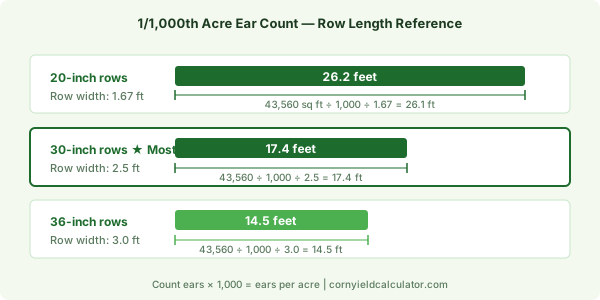
For 30-inch rows, measure 17.4 feet of row and count all ears in that stretch. Multiply by 1,000 to get ears per acre. Use 14.5 feet for 36-inch rows or 26.2 feet for 20-inch rows. Count everything with a harvestable ear — including nubbins — and average at least 5 field locations.
Ears per acre is the first number in the yield formula and the one that moves the final answer the most. The formula is: Yield = [Ears/acre × Rows/ear × Kernels/row] ÷ Kernels/bushel. If your ears-per-acre count is off by 10%, your yield estimate is off by roughly 10%, which on a 200 bu/acre field is 20 bu/acre.
Getting the ear count right is the foundation of an accurate yield estimate. Here's the precise method.
The 1/1,000th Acre Method
The standard method counts ears in exactly 1/1,000th of an acre within the row, then multiplies by 1,000 to scale to a full acre.
One acre of cropland is 43,560 square feet. For a single row of 30-inch (2.5-foot) spacing:
43,560 ÷ 1,000 ÷ 2.5 = 17.4 feet of row
For other row spacings:
| Row Spacing | Row Width (ft) | Length for 1/1,000th Acre |
|---|---|---|
| 20 inches | 1.67 ft | 26.2 feet |
| 30 inches | 2.50 ft | 17.4 feet |
| 36 inches | 3.00 ft | 14.5 feet |
| 38 inches | 3.17 ft | 13.75 feet |
Measure the correct distance with a tape measure or premeasured stake. Some scouts carry a rope cut to the right length for their row spacing, which is faster than pulling out the tape every time.
What Counts as an "Ear"?
Count every stalk within your measured row length that has a harvestable ear — including small nubbins that might be 4–6 inches long. The key question is: will the combine head pick it up?
Count these:
- Normal, fully-filled ears of any size
- Small or irregular ears (nubbins) still attached to the stalk and positioned to be picked by the head
- Tillers with ears, if your hybrid produces tillers in your stand conditions (most don't)
- Barren stalks do NOT count: stalks without any ear development represent lost yield potential, not actual yield
Don't count:
- Ears that have already dropped to the ground (harvest loss)
- Ears from stalks that have lodged severely enough that the head may miss them
- Stalks outside your measured row length
In a field with significant lodging, count dropped or lodged ears separately and estimate what percentage of them the combine will actually recover.
Choosing Your Sampling Locations
Ear count accuracy depends as much on where you sample as how carefully you count.
The cardinal rule: never start a sample within 30 rows of the field edge. Field edges have reduced competition and often significantly higher ear counts, sometimes 15–25% higher than the field interior. Include edge rows in your sample and you'll consistently overestimate yield.
For a 40–80 acre field: 5 locations, evenly distributed across the field.
For a 100–300 acre field: 7–10 locations in a grid or zigzag pattern.
For fields over 300 acres: Consider dividing into management zones and sampling each zone separately.
Where not to sample:
- Near field entrances (compaction from field traffic)
- Around waterways, terraces, or low spots
- Near obviously different soil series (if you want a whole-field average; sample these separately for zone-specific estimates)
- In areas with visible pest damage or disease hot spots unless you want to estimate their impact separately
Recording Your Data Properly
At each location, write down:
1. Location description (NE quarter, center field, etc.) or GPS coordinates
2. Row length measured (should be the same each time)
3. Number of ears counted
4. Any notes on stand issues (lodging, disease, etc.)
Back in the truck, multiply each site's ear count by 1,000 and average across all sites. If one site is dramatically different (say, 28,000 ears in a wet spot vs. 34,000 everywhere else), estimate the proportion of the field that wet spot represents and weight your average accordingly.
Common Counting Errors
Counting partial ears at the ends of your measured distance. Be consistent: either always include the ear if the base of the stalk falls within your marked length, or always exclude it. Inconsistency on this adds error across many samples.
Missing stalks with ears below the normal canopy height. Shorter stalks from late-germinating seeds sometimes have ears positioned near the ground that are easy to overlook while walking the row. Slow down and look low as well as high.
Not counting nubbins. A nubbin of 60–80 kernels on 3,000 stalks contributes roughly 2–3 bu/acre. It's worth counting, especially in stress years where nubbins are more common.
Not averaging enough sites. Within-field variability is real. One or two sample sites can easily swing your estimate by 10–15%. Five sites are the minimum; more is better for large fields.
Calculating Ears Per Acre From Your Count
Once you have your site averages:
Ears/acre = (Sum of all site ear counts ÷ Number of sites) × 1,000
Example:
- Site 1: 32 ears → 32,000/acre
- Site 2: 29 ears → 29,000/acre
- Site 3: 34 ears → 34,000/acre
- Site 4: 31 ears → 31,000/acre
- Site 5: 33 ears → 33,000/acre
Average: (32 + 29 + 34 + 31 + 33) ÷ 5 = 31.8 → 31,800 ears/acre
Enter that number into our corn yield calculator along with your kernel row count and kernels-per-row count to get your bu/acre estimate.
For step-by-step guidance on the full scouting process, including measuring kernel rows and kernels per row, see how to scout corn for yield. To understand how your stand counts relate to planting decisions, read our guide on optimal corn plant population.
Corn Yield Calculator Team
Agronomists and farmers building free, accurate crop scouting tools. Learn about our methodology →
Try the Corn Yield Calculator
Calculate corn yield per acre using ear count, kernel rows, and kernel weight data from your field.