30-Inch vs 20-Inch Row Spacing: Which Yields More?
Narrow-row corn shows a 5–10% yield bump over 30-inch rows in high-yield environments. But equipment costs often outweigh the benefit for most farms.
By Corn Yield Calculator Team · Last updated
Quick Answer
University research consistently shows 20-inch row spacing yields 5–12% more than 30-inch rows in the same environment, primarily because narrower rows achieve canopy closure faster and intercept more sunlight during vegetative growth. The yield advantage is real, but equipment investment and agronomic tradeoffs mean it's not the right choice for every operation.
Row spacing is one of those production debates that's been going on for decades and still generates strong opinions at coffee shops from Ohio to Nebraska. The agronomic answer is actually fairly clear from university research. The farm economics answer is more complicated.
Let's look at what the data actually shows.
Why Row Spacing Affects Yield
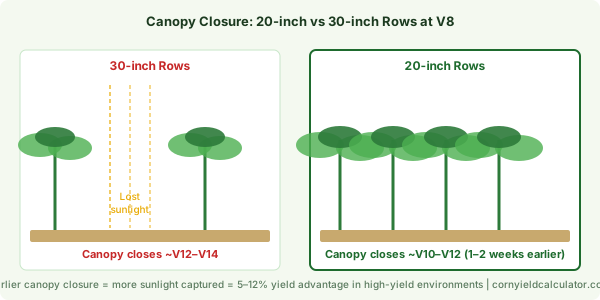
Corn is a sun-loving plant that converts sunlight to dry matter through photosynthesis. The problem with wider row spacing is that for much of the growing season, from emergence through V10, large gaps between rows mean significant sunlight hits bare soil rather than productive leaf area.
At 30-inch spacing, corn doesn't reach full canopy closure (when adjacent rows' leaves overlap to shade most of the soil) until approximately V12–V14, usually early July in the Corn Belt. At 20-inch spacing, canopy closure occurs 1–2 weeks earlier, at V10–V12.
That earlier canopy closure has two yield-relevant effects:
1. More total sunlight intercepted during the critical V6–R1 period, when ear and kernel number are being determined
2. Reduced evapotranspiration from soil surface, which conserves soil moisture for the crop rather than losing it to direct evaporation
Research from Iowa State University and the University of Wisconsin shows that 20-inch rows capture approximately 10–15% more photosynthetically active radiation during the vegetative period than 30-inch rows at the same plant population.
What the University Trials Show
Meta-analyses of university row spacing trials from Iowa State, Purdue, the University of Wisconsin, and Ohio State show consistent but variable results:
- In high-yield environments (180+ bu/acre potential): 20-inch rows yield 8–12% more than 30-inch rows
- In moderate-yield environments (140–180 bu/acre): The advantage drops to 4–8%
- In low-yield, dry environments (under 140 bu/acre): The advantage essentially disappears or can even reverse, because plant competition for water at higher effective populations outweighs light interception benefits
The biggest yield advantage for narrow rows appears in:
- High-yield irrigated environments
- Environments with good early-season moisture but potential mid-season stress (canopy closure earlier protects soil moisture)
- Fields where gray leaf spot or other foliar diseases are endemic, since better airflow in narrow rows can reduce disease pressure
Adjusted Sampling for Narrow Rows
When you're scouting a field in 20-inch rows to estimate yield, your 1/1,000th-acre sample length changes. For 20-inch rows, use 26.2 feet of row rather than the 17.4 feet used for 30-inch rows.
The ear count process is the same; just the row length changes. Enter your ears-per-acre count into our corn yield estimator the same way regardless of row spacing. The formula is agnostic to row width.
The Case For Staying at 30 Inches
Despite the documented yield advantage of narrow rows, the majority of U.S. corn acreage remains at 30 inches for practical reasons.
Equipment cost and compatibility. The most common combine heads, planter frames, and header configurations are designed around 30-inch row widths. Converting to 20-inch requires investing in new planting and harvest equipment, which can run $50,000–$200,000 depending on farm size and existing inventory.
Herbicide applications. Many producers apply herbicides (and in the past, cultivated) between rows. At 20 inches, mechanical cultivation isn't practical, which means relying entirely on pre-emergence and post-emergence chemical control.
Canopy closure and weed management. Narrow rows achieve canopy faster, which suppresses late-season weeds — a benefit. But the dense canopy also makes post-emergence foliar herbicide applications less effective since coverage drops.
Stalk disease and lodging. Some research suggests narrower rows can increase lodging risk in late-season stand-down years, particularly with rootworm damage, because stalks are smaller on average (compensating for higher population density).
Drying and harvest logistics. Higher-moisture grain from narrow-row, high-population stands may come off wetter in some environments, increasing drying costs enough to offset yield gains.
The Financial Calculation
Assume 20-inch rows give you a 7% yield advantage in a 175 bu/acre environment: that's 12.25 additional bushels per acre at $4.50/bu = $55/acre gross benefit.
Equipment amortization on $100,000 of new planter equipment over 10 years on 1,000 acres = $10/acre/year fixed cost.
Operating cost differences (seed, fertilizer, chemicals) may be minimal or slightly higher depending on population adjustments.
Net advantage: potentially $40–45/acre in high-yield environments where the yield response is realized. That's a meaningful number, but it assumes the yield advantage holds in your specific environment and that you don't face agronomic complications that reduce it.
For most operations transitioning from 30-inch to 20-inch rows, the decision makes sense when: (1) you're already facing an equipment replacement decision, (2) you're in a high-yield environment where the research response is strongest, and (3) your herbicide and disease management program can adapt.
Bottom Line
The agronomic case for 20-inch rows is solid in high-yield environments. The practical case for most farms is more nuanced. If you're already operating narrow rows, scout your fields with the appropriate row length and run your data through our corn yield calculator to quantify the yield performance you're actually achieving.
For a broader look at what drives yield differences, see our guide on 7 factors that affect corn yield. Row spacing is one piece of a larger optimization puzzle.
Corn Yield Calculator Team
Agronomists and farmers building free, accurate crop scouting tools. Learn about our methodology →
Try the Corn Yield Calculator
Calculate corn yield per acre using ear count, kernel rows, and kernel weight data from your field.