Top Causes of Corn Yield Loss and How to Prevent Them
Corn yield loss happens at every stage from planting to harvest. Top causes, how many bushels each costs, and the management steps to prevent them.
By Corn Yield Calculator Team · Last updated
Quick Answer
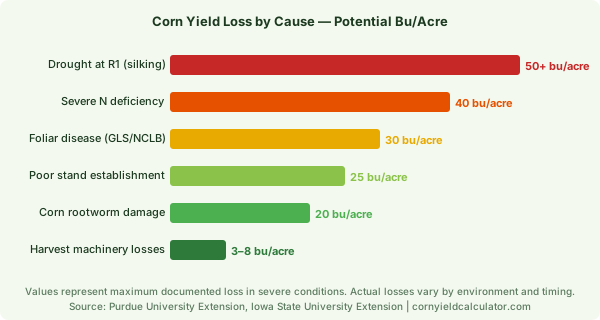
The biggest quantifiable causes of corn yield loss are drought stress during pollination (can cost 30–50% of yield potential), nitrogen deficiency (5–40 bu/acre depending on severity), rootworm damage to root system (5–20 bu/acre in severe cases), foliar disease (10–30 bu/acre in epidemic years), and harvest machinery losses (3–8 bu/acre under normal conditions).
Pre-harvest yield scouting estimates what your crop should produce. But between your estimate and your actual grain check, a lot can still go wrong, and much of it is preventable with the right timing and decision-making.
Here's a realistic breakdown of the most common corn yield loss causes, organized by the stage at which they occur and the management response that addresses each one.
Stand Establishment Losses (Planting Through V3)
Poor Germination and Emergence
Seeds that don't germinate, germinate late, or produce weak seedlings create permanent stand gaps. In most years, 2–5% of seeds fail to establish. In tough years with cold soils (below 50°F for 48+ hours after planting) or heavy rain and crusting, emergence losses can reach 10–15%.
What it costs: Each 1,000 plants below your target costs approximately 4–6 bu/acre in the yield equation, since ears per acre is the first factor in the yield formula.
Prevention: Plant into adequate soil temperature (50°F minimum, 55°F+ preferred). Use seed treatments with fungicide and insecticide components in cold, wet conditions. Consider a planting date delay rather than planting into marginal conditions. A May 10 planting in Iowa often outperforms an April 25 planting made into cold, wet soils.
Imbibitional Chilling
When dry seed absorbs cold water (below 50°F) during the first 24–48 hours after planting, the germination process can be permanently disrupted. Seeds that imbibed cold water may show abnormal germination with corkscrew roots, swollen seeds that never crack open, or seedlings that emerge and then die.
What it costs: Variable, but can wipe out 5–20% of stand in severe cold-imbibition events.
Prevention: Check soil temperature at seeding depth before planting. Monitor forecasts. A rapid cold rain immediately after planting is the high-risk scenario.
Vegetative Stage Losses (V1–V12)
Nitrogen Deficiency and Loss
Nitrogen is mobile in soil and vulnerable to loss from the time it's applied. Pre-plant urea can lose 15–30% of its applied N to volatilization and leaching in wet springs. Fall-applied anhydrous ammonia can lose 20–40% to denitrification in waterlogged soils.
What it costs: In severe N deficiency, corn can lose 0.5–1.0 bu/acre for every pound of N below its requirement. A 40 lb/acre N deficit on a 200-yield crop costs 40–80 bu/acre, a dramatic penalty.
Prevention: Split applications reduce risk. Side-dress at V4–V6 into standing corn rather than pre-plant in high-leaching risk environments. Stabilizers on fall or early spring applications reduce loss. Use late-spring soil nitrate test (LSNT) to calibrate N rates to soil conditions.
Soil Compaction
Compaction from wet-field traffic during planting or spring fieldwork restricts root growth, reduces water infiltration, and can cut N uptake by 15–25% in severely compacted areas.
What it costs: 10–30 bu/acre in severely compacted zones; 5–10 bu/acre in moderately compacted areas. In-season compaction effects are often invisible until you pull up roots and see the shallow, compressed root system.
Prevention: Minimize field traffic when soils are wet. Establish wheel traffic lanes where possible. Consider subsoil tillage (vertical tillage or chisel plow) on historically compacted fields.
Pollination Stage Losses (VT–R2)
Drought Stress at Silking
Corn is most vulnerable to water stress during the 2-week window around pollination — from just before tasseling through R2 (blister stage). Silk desiccation (silks drying before pollen reaches them) prevents fertilization, creating blank kernel zones on the ear.
What it costs: Each day of severe drought stress during silking can reduce kernel set by 3–8%. A 10-day drought during VT–R1 in a hot year can cut kernel number by 30–60% of potential — the most dramatic single-event yield loss possible.
Prevention: In irrigated systems, ensure soil moisture stays above 50% field capacity during VT–R1. In dryland systems, choose hybrids with proven drought tolerance and synchronous pollination (short ASI — anthesis-silk interval). Avoid using all available irrigation water for vegetative growth and having none left for the critical pollination window.
Heat Stress and Pollen Viability
Pollen grains are viable for 2–8 hours after shedding. Above 95°F, pollen viability drops dramatically and pollen shed is reduced. On days exceeding 100°F, effective pollination can be nearly zero.
What it costs: 8% yield loss per day above 95°F during pollination (Iowa State research). A 5-day heat event during silking costs roughly 40% of kernel set potential.
Prevention: Hybrid selection — choose hybrids with high heat unit requirements for your area that shift pollination timing away from the peak heat risk window. In most of the Corn Belt, full-season hybrids pollinate in late June to early July when temperatures are typically more moderate than in late July.
Grain Fill Losses (R3–R6)
Gray Leaf Spot and Northern Corn Leaf Blight
Foliar diseases that reduce green leaf area during grain fill directly reduce dry matter accumulation per kernel. Gray leaf spot (GLS) and northern corn leaf blight (NCLB) are the most economically significant in most Corn Belt states.
What it costs: A GLS epidemic that defoliates the top 3 leaves during grain fill can cost 20–40 bu/acre on a susceptible hybrid. Moderate infection (30% defoliation) typically costs 10–15 bu/acre.
Prevention: Hybrid resistance is the primary tool — choose hybrids with ratings of 7+ on a 1–9 scale for diseases endemic in your area. A single fungicide application at VT–R1 can add 8–15 bu/acre ROI on susceptible hybrids in high-disease-pressure years.
Stalk Rot from Rootworm or Late-Season Diseases
Corn rootworm larvae feeding on roots during V6–V8 reduce the root system available for water and nutrient uptake later in the season. In severe infestations, root ratings drop below 3.0 on the Iowa State 0–3 scale, causing visible lodging and yield penalties from both nutrient stress and harvest losses.
What it costs: Root rating below 3.0 correlates with 5–15 bu/acre yield loss from stress effects. Additional harvest losses from lodged ears can add 3–8 bu/acre on severely affected fields.
Prevention: Crop rotation is the most effective and cost-efficient management tool. Rootworm populations that have developed resistance to corn rootworm hybrids (Bt proteins) are a growing concern — monitor for unexpected damage even in traited hybrids.
Harvest Losses (R6 Through Harvest)
Header and Cylinder Losses
A well-adjusted combine should lose 2–4 bu/acre under typical conditions. Poor head height, aggressive snapping rolls, or improper cylinder speed settings can push losses to 8–12 bu/acre.
What it costs: Every 1 bu/acre of additional harvest loss at $4.50/bu = $4.50/acre. On 1,000 acres, the difference between 3 bu/acre loss and 6 bu/acre loss is $13,500 per season.
Prevention: Calibrate your header and measure harvest losses before major harvest begins. Walk behind the combine on a test strip and count kernels and whole ears on the ground. More than 2 kernels per square foot = approximately 1 bu/acre header loss.
Pre-harvest Field Losses
Stalks that lodge before the combine arrives, ears that drop before harvest, and ears attached to lodged stalks that the head misses all represent yield you grew but didn't capture.
What it costs: In bad lodging years, 5–15% of yield potential may be lost to pre-harvest and harvest inefficiency combined.
Prevention: Scout stalk health at R5.5 by push-testing 20 stalks per site. Fields with >20% of stalks failing the push test should be prioritized for early harvest before further lodging occurs.
Knowing what you grew before harvest is the first step to understanding what you might lose. Estimate your pre-harvest corn yield using our field scouting tool, then compare your estimate to your combine yield monitor data. The gap between estimate and actual tells you where losses are occurring on your operation.
For a broader view of yield drivers, read 7 factors that affect corn yield. To understand how harvest moisture affects your final grade and payment, see corn harvest moisture.
Corn Yield Calculator Team
Agronomists and farmers building free, accurate crop scouting tools. Learn about our methodology →
Try the Corn Yield Calculator
Calculate corn yield per acre using ear count, kernel rows, and kernel weight data from your field.