U.S. and World Record Corn Yields: What's Possible?
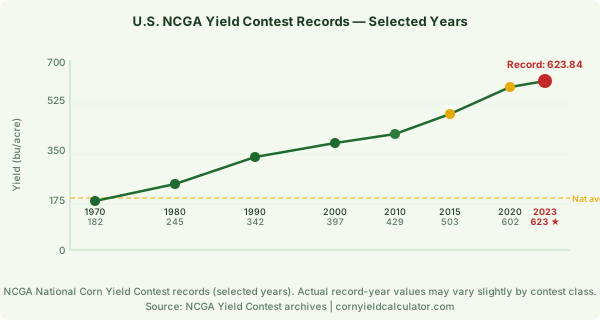
The NCGA record stands at 623 bu/acre, over three times the national average. Here is what record yields teach us about the biological ceiling.
By Corn Yield Calculator Team · Last updated
Quick Answer
The current U.S. corn yield record is 623 bu/acre, set by David Hula of Virginia in 2023 through the National Corn Growers Association (NCGA) contest. The world record under FAO guidelines is similar. These record yields require optimized hybrids, precise nitrogen management, irrigation, intensive scouting, and growing conditions that align perfectly.
The U.S. national average corn yield was around 177 bu/acre in 2024. David Hula's contest record stands at 623 bu/acre. That's 3.5 times the national average from the same crop in the same country.
Understanding what drives those extreme yields and what separates them from average production teaches you something useful about what's limiting your own fields.
The Record: David Hula's 623 Bu/Acre
David Hula, a farmer in Charles City, Virginia, set the NCGA yield contest record of 623.84 bu/acre in 2023, surpassing his own previous records. Hula has won the NCGA Yield Contest multiple times, making him arguably the most successful corn yield competitor in the history of the contest.
The field sits in the coastal plain of Virginia, where the combination of long growing seasons, sandy loam soils with excellent drainage, and access to Shenandoah Valley irrigation water creates an unusual set of advantages. But the field conditions alone don't explain the record. Hula's management intensity does.
What Goes Into a Record Corn Yield?
According to NCGA contest documentation and agronomic analysis of high-yield entries, record-level corn yields require all of the following simultaneously:
Hybrid Genetics
Contest winners use proprietary high-yield genetics, often elite inbreds combined through experimental or commercial hybrid programs that are specifically selected for maximum yield under intensive management. These hybrids are not necessarily the same ones that perform best on average. They're hybrids that respond most dramatically to optimal conditions.
Typical contest hybrid traits:
- Deep kernels with exceptional test weight (58–62 lbs/bu is common in record entries)
- Outstanding root architecture for nutrient uptake at very high populations
- Strong staygreen characteristics to extend grain fill duration
- Disease package capable of handling dense canopy conditions
Plant Population
Most NCGA record entries use 40,000–48,000 seeds/acre, well above the 30,000–34,000 that most commercial producers target. At these high populations, every management factor must be optimized, because stand uniformity, nitrogen availability, and water supply must all accommodate extremely competitive intra-field conditions.
At 45,000 plants/acre, you have roughly 25% more ears per acre than a commercial field at 34,000. If all other factors hold, that adds roughly 20–25% to raw yield potential before you account for compensatory effects (smaller ears, lighter kernels).
Nitrogen and Nutrient Management
Record yields require extraordinary nitrogen rates. Analyses of NCGA contest winners frequently show N applications of 300–450 lbs/acre or higher, split across multiple timing windows: fall, spring pre-plant, at-plant starter, V4 side-dress, and in some cases a late-season in-furrow application during grain fill.
The critical insight is that N must be available in the right form at the right time. Too much N applied too early is vulnerable to loss. Contest growers typically use multiple stabilizer technologies and split applications to time N availability with peak crop demand during V6–R1.
Water
All record-level corn yields occur on irrigated fields. The national average includes millions of dryland acres where summer drought is the yield-limiting factor. Contest growers in Virginia, Nebraska, and other top-performing states use center-pivot or drip irrigation to maintain optimal soil moisture throughout the season, ensuring plants never experience water stress during pollination or grain fill.
Intense Monitoring and Precision Management
Contest growers scout their fields multiple times per week during critical growth stages. They use plant tissue testing to identify nutrient deficiencies in real time, adjust irrigation schedules to soil moisture sensor data, and scout aggressively for disease, rootworm, and lodging risk.
The time investment is enormous. Most contest growers dedicate a specific, small plot, often 1–5 acres, to their contest field to enable this management intensity.
What the Records Teach Us About Yield Gaps
The gap between the national average and the theoretical yield ceiling has important implications. Agronomists at the University of Nebraska and elsewhere estimate that the biological potential of corn (the maximum yield achievable given adequate sunlight, CO₂, water, and nutrients) is approximately 500–600 bu/acre under perfect conditions. Contest yields approach that ceiling, though truly achieving it requires every system to be perfectly aligned.
The "exploitable yield gap," the difference between your actual yields and what's achievable on your soils with better management, is typically estimated at 40–60 bu/acre for most Corn Belt producers. That gap represents: better hybrid selection for your environment, more precise N management, improved drainage or irrigation, and reduced stand establishment losses.
Realistic High-Yield Targets
Contest yields are not a relevant benchmark for commercial production. But yield contests do identify management practices that move the needle. The most consistently documented high-yield practices that pay off at commercial scale are:
- Eliminating stand establishment losses: achieving 97%+ emergence from seeded population
- Split nitrogen applications with side-dress timing at V4–V6
- Fungicide at VT–R1 in high-disease-pressure environments with susceptible hybrids
- Precision drainage to keep soils optimally managed during wet periods
- Optimized hybrid selection based on multi-year, multi-location university trial data
The NCGA Yield Contest winner is interesting, but your most useful benchmark is your own best year and your county average. Close that gap first before chasing contest-level management practices.
Curious what your field can actually produce this season? Scout it at R4–R5 and run your data through our corn yield calculator for a realistic pre-harvest estimate. For context on what's driving your yields, read our detailed guide on 7 factors that affect corn yield or check your performance against average corn yields by state.
Corn Yield Calculator Team
Agronomists and farmers building free, accurate crop scouting tools. Learn about our methodology →
Try the Corn Yield Calculator
Calculate corn yield per acre using ear count, kernel rows, and kernel weight data from your field.